Friday, December 29, 2006

Somalia: Ethiopians occupy Mogadishu

Somalia: Warlord back to his base in Mogadishu
SomaliNet
Mohamed Qanyare Afrah, a member of parliament and among former warlords, who returned to Mogadishu capital on Friday under the protection of Ethiopian forces, said he was very happy about the new change in Somalia and he is welcoming the ousting of Islamic Courts Union from the capital.

Mr. Qanyare, who returned to his residence in Mogadishu, told the local media that he is against the plan in which the government wants to disarm the militias without giving their rights. “The militias should see the government as their own,” he said.

“In my point of view, I do reject to say to the militia put down the weapons and leave for good, because if the militias who have nowhere to go are ordered to do that, they would damage the security. I would suggest the transitional federal government to consider that and make the militias themselves as government soldiers,” said Qanyare. “The government should place the militia instead of discharging them,”

Mr. Qanyare, once one of powerful warlords in Somalia, also welcomed the Ethiopian forces' entry into the capital without clashes.

“Ethiopian forces should be thanked for their military operation against the so-called Islamic Courts which made the country base for terrorists,” said Qanyare. “The rule of Al-Qaeda members in Somalia has ended in failure and Somalis got their freedom back,”

He confirmed that he is fully working with the government for restoring the law and order in the capital.

Mohamed Qanyare, an MP, said in a happy mood he had changed his position of being a warlord and is now ready to participate in reconstruction of Somalia.

He said since the warlords were defeated in Somalia, they put out where the terrorists are hiding in the country. “The fighting we had with the courts was successful because we showed the world the cave of extremists in horn of Africa,”

In Mogadishu, people feel that warlords are returning to their former positions with acts of retaliations against the remnant of Islamic members in the capital. Some see the returning of the warlords as negative to the peace and security in Somalia.
Somalis Split as Fighting Halts and Hint of Insurgency Looms
New York Times
By JEFFREY GETTLEMAN
Published: December 30, 2006
ADDIS ABABA, Ethiopia, Dec. 29 — Anti-Ethiopia riots erupted in Mogadishu, the capital of Somalia, on Friday, while masked gunmen emerged for the first time on the streets, a day after Ethiopian-backed troops captured the city from Islamist forces.

Hundreds of Somalis flooded into bullet-pocked boulevards to hurl rocks at the Ethiopian soldiers, set tires on fire and shout anti-Ethiopian slogans.

“Get out of our country!” they yelled. “We hate you, Ethiopians!”

In northern Mogadishu, residents said men with scarves over their faces and assault rifles in their hands lurked on the street corners. Mogadishu has plenty of gunmen, of every age and every clan, but gunmen hiding their identity is something new and may be a sign of a developing insurgency.

“We’re going to turn this place into another Iraq,” said Abdullahi Hashi, a construction worker who said he was part of a new underground movement to fight the Ethiopians.

Many analysts have said that if the Ethiopian troops protecting the internationally recognized transitional government of Somalia linger in the country too long and their intervention turns into a full-scale occupation, it will uncork a long and nasty guerilla war.

At the same time, it seems that many Somalis appreciate the presence of the Ethiopians for helping to bring some stability. Just a few hours after the protests, thousands of residents came out to warmly greet Ali Mohammed Gedi, the prime minister of the transitional government and one of the leaders who called in the Ethiopian muscle.

It is unclear what is going to happen in Mogadishu. Many people are still absorbing the dramatic power shift that occurred this week, when the Islamists who once ruled much of the country quickly collapsed under Ethiopia’s overwhelming force, enabling the transitional government, which had been roundly dismissed as weak, to suddenly take control.

Islamist leaders said Friday that they were not simply giving up. While most of their troops have abandoned the cause — shedding their uniforms and shaving their beards — the Islamist leadership said it was regrouping in Kismayo, a city along Somalia’s southern coast. Not far from Kismayo is a lightly populated, heavily forested area that Western intelligence officers said has served as a terrorist hide-out for many years.

“We will not leave Somalia,” Sheik Sharif Sheik Ahmed, a top Islamist leader, told The Associated Press on Friday. “We will not run away from our enemies. We will never depart from Somalia. We will stay in our homeland.”

The Islamists uttered similar vows to fight to the death for Mogadishu, their former stronghold. But when thousands of Ethiopian fighters and troops from the transitional government reached the city’s outskirts on Wednesday, the Islamists fled and the city fell the next morning without a shot.

Ethiopian officials have justified the intervention in Somalia by saying that the Islamists were extremists who had their eyes on part of Ethiopia, and said their troops would remain on Somali soil until that threat is wiped out. The Ethiopian and transitional government troops seem to be focused on Mogadishu, but many Somalis suspect that once that city is stabilized, the bulk of the Ethiopian forces will shift to Kismayo. On Friday, Kismayo residents said Ethiopian fighter jets were circling the skies above town.

Mr. Gedi, meanwhile, is wasting little time getting to work. He announced Friday that the transitional government, one of the most promising efforts at a central government since 1991, when Somalia descended into anarchy, was imposing martial law for the next three months. He asked Mogadishu’s various clan militias to turn in their weapons or face the consequences.

“This country has been through a lot of anarchy,” Mr. Gedi said, “so to re-establish order we will have to have an iron hand.”

Last year, when Mr. Gedi set foot in the capital, he was nearly assassinated. On Friday, he was surrounded by armored trucks and Ethiopian infantrymen. Though officials in Addis Ababa, Ethiopia’s capital, have said their troops should not enter downtown Mogadishu, many are camped in the former American Embassy, a decrepit building that was closed more than 15 years ago after American soldiers suffered a humiliating defeat at the hands of warlords.

Mohammed Ibrahim and Yuusuf Maxamuud contributed reporting from Mogadishu, Somalia.

Thursday, December 28, 2006

President Ford Disagreed With Bush About Invading Iraq

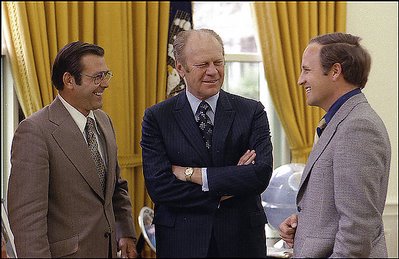
President Gerald R. Ford, center, with Chief of Staff Donald H. Rumsfeld, left, and Rumsfeld’s assistant, Dick Cheney, on April 28, 1975.

FORD Quote 1: Well, I can understand the theory of wanting to free people. Whether you can detach that from the obligation number one, of what’s in our national interests, there comes a point where they conflict. And I just don’t think we should go hellfire damnation around the globe freeing people, unless it is directly related to our own national security.

FORD Quote 2 : I don’t think if I had been president, on the basis of the facts as I saw them publicly, I don’t think I would have ordered the Iraqi war. I would have maximized our effort through sanctions, through restrictions, whatever, to find another answer.

FORD Quote 3 : I think Rumsfeld, Cheney and the president made a big mistake in justifying going into the war in Iraq. They put the emphasis on weapons of mass destruction.

FORD Quote 4 : And now, I’ve never publicly said I thought they made a mistake, but I felt very strongly it was an error in how they should justify what they were going to do.


Ford Disagreed With Bush About Invading Iraq
By Bob Woodward
Washington Post Staff Writer
Thursday, December 28, 2006; A01

Former president Gerald R. Ford said in an embargoed interview in July 2004 that the Iraq war was not justified. “I don’t think I would have gone to war,” he said a little more than a year after President Bush launched the invasion advocated and carried out by prominent veterans of Ford’s own administration.

In a four-hour conversation at his house in Beaver Creek, Colo., Ford “very strongly” disagreed with the current president’s justifications for invading Iraq and said he would have pushed alternatives, such as sanctions, much more vigorously. In the tape-recorded interview, Ford was critical not only of Bush but also of Vice President Cheney -- Ford’s White House chief of staff -- and then-Defense Secretary Donald H. Rumsfeld, who served as Ford’s chief of staff and then his Pentagon chief.

“Rumsfeld and Cheney and the president made a big mistake in justifying going into the war in Iraq. They put the emphasis on weapons of mass destruction,” Ford said. “And now, I’ve never publicly said I thought they made a mistake, but I felt very strongly it was an error in how they should justify what they were going to do.”

In a conversation that veered between the current realities of a war in the Middle East and the old complexities of the war in Vietnam whose bitter end he presided over as president, Ford took issue with the notion of the United States entering a conflict in service of the idea of spreading democracy.

“Well, I can understand the theory of wanting to free people,” Ford said, referring to Bush’s assertion that the United States has a “duty to free people.” But the former president said he was skeptical “whether you can detach that from the obligation number one, of what’s in our national interest.” He added: “And I just don’t think we should go hellfire damnation around the globe freeing people, unless it is directly related to our own national security.”

The Ford interview -- and a subsequent lengthy conversation in 2005 -- took place for a future book project, though he said his comments could be published at any time after his death. In the sessions, Ford fondly recalled his close working relationship with key Bush advisers Cheney and Rumsfeld while expressing concern about the policies they pursued in more recent years.

“He was an excellent chief of staff. First class,” Ford said. “But I think Cheney has become much more pugnacious” as vice president. He said he agreed with former secretary of state Colin L. Powell’s assertion that Cheney developed a “fever” about the threat of terrorism and Iraq. “I think that’s probably true.”

Describing his own preferred policy toward Saddam Hussein’s Iraq, Ford said he would not have gone to war, based on the publicly available information at the time, and would have worked harder to find an alternative. “I don’t think, if I had been president, on the basis of the facts as I saw them publicly,” he said, “I don’t think I would have ordered the Iraq war. I would have maximized our effort through sanctions, through restrictions, whatever, to find another answer.”

Ford had faced his own military crisis -- not a war he started like Bush, but one he had to figure out how to end. In many ways those decisions framed his short presidency -- in the difficult calculations about how to pull out of Vietnam and the challenging players who shaped policy on the war. Most challenging of all, as Ford recalled, was Henry A. Kissinger, who was both secretary of state and national security adviser and had what Ford said was “the thinnest skin of any public figure I ever knew.”

“I think he was a super secretary of state,” Ford said, “but Henry in his mind never made a mistake, so whatever policies there were that he implemented, in retrospect he would defend.”

In 1975, Ford decided to relieve Kissinger of his national security title. “Why Nixon gave Henry both secretary of state and head of the NSC, I never understood,” Ford said. “Except he was a great supporter of Kissinger. Period.” But Ford viewed Kissinger’s dual roles as a conflict of interest that weakened the administration’s ability to fully air policy debates. “They were supposed to check on one another.”

That same year, Ford also decided to fire Defense Secretary James R. Schlesinger and replace him with Rumsfeld, who was then Ford’s White House chief of staff. Ford recalled that he then used that decision to go to Kissinger and say, “I’m making a change at the secretary of defense, and I expect you to be a team player and work with me on this” by giving up the post of security adviser.

Kissinger was not happy. “Mr. President, the press will misunderstand this,” Ford recalled Kissinger telling him. “They’ll write that I’m being demoted by taking away half of my job.” But Ford made the changes, elevating the deputy national security adviser, Brent Scowcroft, to take Kissinger’s White House post.

Throughout this maneuvering, Ford said, he kept his White House chief of staff in the dark. “I didn’t consult with Rumsfeld. And knowing Don, he probably resented the fact that I didn’t get his advice, which I didn’t,” Ford said. “I made the decision on my own.”

Kissinger remained a challenge for Ford. He regularly threatened to resign, the former president recalled. “Over the weekend, any one of 50 weekends, the press would be all over him, giving him unshirted hell. Monday morning he would come in and say, ‘I’m offering my resignation.’ Just between Henry and me. And I would literally hold his hand. ‘Now, Henry, you’ve got the nation’s future in your hands and you can’t leave us now.’ Henry publicly was a gruff, hard-nosed, German-born diplomat, but he had the thinnest skin of any public figure I ever knew.”

Ford added, “Any criticism in the press drove him crazy.” Kissinger would come in and say: “I’ve got to resign. I can’t stand this kind of unfair criticism.” Such threats were routine, Ford said. “I often thought, maybe I should say: ‘Okay, Henry. Goodbye,’ “ Ford said, laughing. “But I never got around to that.”

At one point, Ford recalled Kissinger, his chief Vietnam policymaker, as “coy.” Then he added, Kissinger is a “wonderful person. Dear friend. First-class secretary of state. But Henry always protected his own flanks.”

Ford was also critical of his own actions during the interviews. He recalled, for example, his unsuccessful 1976 campaign to remain in office, when he was under enormous pressure to dump Vice President Nelson A. Rockefeller from the Republican ticket. Some polls at the time showed that up to 25 percent of Republicans, especially those from the South, would not vote for Ford if Rockefeller, a New Yorker from the liberal wing of the Republican Party, was on the ticket.

When Rockefeller offered to be dropped from the ticket, Ford took him up on it. But he later regretted it. The decision to dump the loyal Rockefeller, he said, was “an act of cowardice on my part.”

In the end, though, it was Vietnam and the legacy of the retreat he presided over that troubled Ford. After Saigon fell in 1975 and the United States evacuated from Vietnam, Ford was often labeled the only American president to lose a war. The label always rankled.

“Well,” he said, “I was mad as hell, to be honest with you, but I never publicly admitted it.”

Christine Parthemore contributed to this report.

Tuesday, December 19, 2006

Long, Ideological War Ahead

I listened to the tape of this interview and he punched this line hard twice: " this ideological war we're in is going to last for a while".

Transcript Excerpt: The Post's Interview With President Bush
The Washington Post
Tuesday, December 19, 2006; 4:20 PM

Washington Post reporters Peter Baker, Michael Fletcher and Michael Abramowitz interviewed President Bush at the White House earlier today. Below is a transcript excerpt from their conversation.

President Bush: Listen, a couple of things before we get going. Obviously, I've been thinking about -- and talking to a lot of people about the way forward in Iraq and the way forward in this ideological struggle. I want to share one thought I had with you, and I'm inclined to believe that we do need to increase our troops, the army, the Marines. And I talked about this to [Defense] Secretary [Robert M.] Gates and he is going to spend some time talking to the folks in the building, come back with a recommendation to me about how to proceed forward on this idea. I want to give him a little time to get his feet on the ground. And so I'll be addressing this after consultations with him. I just want to share that with you before we get going.

Q. You're talking about troops in Iraq, not --

No, I'm talking about overall size.-

- overall size of the army. Do you have a rough idea how much --

I'm going to wait for Secretary Gates. As I say, I'm inclined to believe it's important and necessary to do so. The reason why is, it is a accurate reflection that this ideological war we're in is going to last for a while, and that we're going to need a military that's capable of being able to sustain our efforts and to help us achieve peace.

So you've not made a decision about Iraq, per se, about what to do --

I have not, Mike, I have not. And we'll spend some more time -- Secretary Gates, as he indicated, is going to head to the region at some point in time. I need to talk to him when he gets back. I've got more consultations to do with the national security team, which will be consulting with other folks. And I'm going to take my time to make sure that the policy, when it comes out, the American people will see that we are -- have got a new way forward to achieve an important objective, which is a country that can govern, sustain and defend itself.

And one thing that will be clear is that I want the American people to know that -- and the Iraqi people to know -- that we expect the Iraqi people to continue making hard choices and doing hard work necessary to succeed, and our job is to help them do so.

I'd like to come back to your first statement, because I'd like to expand a little bit. You talked about the size of the military. Colin Powell said on a Sunday show that the Army was nearly broken. Do you believe that's true? And, if so, do you feel responsible for that? Do you --

I heard -- we have been transforming our Army to make it lighter, more lethal and easier to move, and that transformation has been very important. Secondly, we have been changing our force posture around the world to reflect the threats of the 21st century, and that has been a very important reform.

I also believe that the suggestions I've heard from outside our government, plus people inside the government -- particularly, the Pentagon -- that we need to think about increasing our force structure makes sense, and I will work with Secretary Gates to do so. He's going to come back and report --

So is our army nearly broken, or not?

The people that would know best are those in the Pentagon. I haven't heard the word "broken," but I've heard the word "stressed." I know that we need to -- and my budgetary requests will reflect what a lot of people in Congress have been saying and in the Pentagon, and that is we need to reset our military. There's no question the military has been used a lot. And the fundamental question is, will Republicans and Democrats be able to work with the administration to assure our military and the American people that we will position our military so that it is ready and able to stay engaged in a long war, and this ideological struggle?

Monday, December 18, 2006

Article: Nothing New Here—And That's the Point


In California, 10 Friends Eschew Consumer Culture to Live Secondhand
By William Booth
Washington Post Staff Writer
Monday, December 18, 2006; A01

SAN FRANCISCO -- In the living room, the group gathers to share inspirational stories about the joy of finding just the right previously owned shower curtain. To the uninitiated, these people appear almost normal, at least in a San Francisco kind of way. But upon closer inspection, you see it: Nothing in this house, nothing on their bodies, none of their products -- nothing is new. Everything is used.

For these people, recycling wasn't enough. Composting wasn't a challenge anymore. No, they wanted much more of much less.

Attention holiday shoppers! These people haven't bought anything new in 352 days -- and counting. These 10 friends vowed last year not to purchase a single new thing in 2006 -- except food, the bare necessities for health and safety (toilet paper, brake fluid) and, thankfully, underwear, and maybe socks (they're still debating whether new socks are okay).

Everything else they bought secondhand. They bartered or borrowed. Recycled. Re-gifted. Reused. Where? Thrift stores and swap meets, friends and Dumpsters, and the Internet, from Craigslist to the Freecycle Network, which includes 3,843 communities and 2.8 million members giving away stuff to one another.

These people purchased old sheets this year. Tonight's vegetarian feast was cooked in a hand-me-down Crock-Pot. Christmas presents? They're making them, or -- shudders -- they don't give them.

They call their little initiative "the Compact," which they say has something to do with the Mayflower and the Pilgrim pledge to live for the greater good, save the planet, renew their souls, etc. And although these modern "Compactors" say they never intended to spark a mini-movement or appear on the "Today" show, that is exactly what has happened.

Since the San Francisco Chronicle ran an article about them in February, their story of not buying has appeared on media outlets around the world -- everything from Yoga Journal to Martha Stewart's Body + Soul to the London Times. Even Oprah's producers called.

It appears they've pinched a nerve. Perhaps, the Compactors suggest, many people have the same feeling that the mall just isn't working for them anymore.

"We're just rarefied middle-class San Francisco greenies having a conversation about consumption and sustainability," says John Perry, a marketing executive with a high-tech firm, and one of the founding Compactors. "But suddenly, we decide we're not going to buy a bunch of new stuff for a year? And that's international news? Doesn't that say something?"

Their user group on Yahoo has grown to 1,800 registered members, representing SubCompact cells operating across the country (including Washington), and around the planet. So they apparently live among us, biding their time, quietly not buying, like some kind of Fifth Column of . . . Shakers.

The online Compact community ( http://groups.yahoo.com/group/thecompact) spends enormous amounts of typing-time discussing things most Americans probably do not. Such as how to make soap. Or whether a mousetrap counts as a safety necessity. Or how to explain to your children that Santa Claus traffics in used toys.

"And people hate us for it? Like it drives them nuts?" This is Shawn Rosenmoss, an environmental engineer in the original San Francisco group. Some have called the Compactors un-American, anti-capitalist, eco-freak poseurs whose defiant act of not-consuming, if it caught on, would destroy the economy and our way of life.

Kalle Lasn, editor of Adbusters magazine, who advocates taking a 24-hour timeout of the consumer merry-go-round, has promoted Buy Nothing Day since 1992, urging citizens to resist the urge to splurge on the day after Thanksgiving, the kickoff to the holiday shopping spree.

Lasn claims that millions of people have stopped shopping on Buy Nothing Day, although he admits there is no way to know for sure. But Lasn does know that Internet discussion about the movement has grown, and so, too, the backlash -- against the backlash.

"I go on talk radio shows, and I'm amazed by the anger of some people, the Chamber of Commerce president who calls up and says, 'You're trying to ruin the economy,' " Lasn says. "I sympathize. I know you have to pay your rent, but try to take the larger view. We consume three times more than we did right after World War II. These things are connected."

"I think it upsets people because it seems like we're making a value judgment about them," says Rosenmoss, who has two children. "When we're simply trying to bring less . . . into our house."

What are the rules to this particular game? "People are really into the rules," Perry says, "as if it were a game, which it kind of is. I like that part of it. Figuring out how to do what I need to do without running out and buying something."

The rules are simple -- and flexible. The original Compactors decided they would get to vote on anything in the gray areas.

One member recalls asking permission to purchase a new toilet brush, contending that it was a health issue. Overruled. How about a new house key? Allowed. New tubes of shampoo, toothpaste, sunscreen are okay, but skin bronzer would be frowned upon.

At the potluck supper, the family dog is playing with a toy, which looks like a ball of yarn. Technically, it is new, and thus a Compact breaker. "But if she eats it," points out Rachel Kesel, a professional dog walker, "then it's food."

"We all have our little weaknesses," says Kate Boyd, a schoolteacher and set designer. Her challenge was getting used bicycle shoes, plus a used helmet and pump. Three buys through Craigslist through three sellers. "It was more of a hassle than going to the bike store," she says, but more interesting, too. "You get to meet new people."

The greatest challenge of the Compact? "The strangest things," Perry explains. For example, he cannot find used shoe polish.

Then there are modern dilemmas. Is it better to buy a battery (allowed, if recycled and rechargeable) for a cellular phone for $70 or just have the company give you a new free phone if you switch providers?

Clothes? Easy, they say. Vintage stores. Consignment shops. Or more down-market, your Goodwill, your Salvation Army. Or your own closet, likely filled with outfits.

Toys? The easiest. Perry and his partner, Rob Picciotto, a high school language teacher, have two adopted children. "I take Ben to Target sometimes and we'll play with the toys and then leave," Picciotto says. The kid seems happy.

"I broke down and bought a drill bit," Rosenmoss says. The Compactors nod their heads. "I just wanted it and I needed and I did it." The group members understand. They've had their drill-bit moments.

But not a lot of them. Asked what they bought that broke the Compact, the list was not long: some sneakers, the drill bit, a map, and for Sarah Pelmas and her newlywed husband, Matt Eddy (fellow Compactors), some energy-efficient windows for the house renovation. The 1920s house, they remind us, was purchased used. Indeed, they painted it with recycled paint.

"By being so strict with yourself, you learn to take a deep breath," Kesel says.

"You learn to do away with the impatience." Boyd says, "You see that the craving will pass."

One Compactor points out that the group's members are not really denying themselves much. Boyd says that, for example, by buying less new, "I drink way better wine now." Also allowed: services. So they could buy a massage if they wanted to. They can go to movies, theater, concerts, museums, bars, music clubs and restaurants. They can fly, drive (and buy gas), stay in hotels.

Judith Levine, author of "Not Buying It: My Year Without Shopping," went really cold turkey in 2004 with her husband. The couple split their time between Brooklyn and Vermont. She applauds the Compactors, but says that not buying stuff for a year is only taking it halfway. Not going to the movies and restaurants for a year -- now that's cutting back.

Amazingly, the Compactors have all decided to renew their pledge for another year. There are, naturally, things they miss, and so they've decided to give themselves one day next month when they can buy a few things they really need new.

Like? "I need a drain snake," Perry says. Is that not pitiful?

Pelmas is dying for new pillowcases. Used pillowcases, even this group agrees, are rather disgusting.

Lessons learned?

"We didn't do this to save the world. We did this to improve the quality of our own lives," Perry says. "And what we learned is that we all have a lot of more stuff than you think, and that you can get along on a lot less stuff than you can imagine."

Friday, December 15, 2006

Article: Opec to cut output in February, "…increasing spare capacity"


Opec to cut output in February
By Ed Crooks and Dino Mahtani in Abuja and Carola Hoyos in London
Published: December 14 2006 14:31 | Last updated: December 14 2006 19:59
Financial Times

The Organisation of the Petroleum Exporting Countries on Thursday moved to reassert its power over oil prices by agreeing to cut production early next year in spite of rising concerns over tightening world crude markets.

Opec ministers meeting in Abuja agreed to cut output by 500,000 barrels a day from February 1. The move followed a 1.2m b/d cut announced in October, and sent prices higher.

Crude prices rose, with January West Texas Intermediary crude rising $1.14 to $62.53 in lunchtime New York trading. The WTI benchmark price has now risen 10 per cent in the last month.

Opec also broadened its reach by adding Angola as a member – boosting its share of world production from 40 to 43 per cent – while also calling a rare heads of state summit next year in Riyadh.

The last time Opec met in Saudi Arabia was in 1980. In its 46-year history, Opec has held only two summits of heads of state, with the most recent one in 2000 in Caracas.

Analysts saw the move as highlighting Saudi Arabia’s increasing assertiveness within the cartel, which comes as Riyadh is also stepping up its political activity in the Middle East, even at the risk of angering the US, its major western ally.

Adam Sieminski, chief energy economist at Deutsche Bank, said: “In addition to flexing its muscle externally, Saudi Arabia, with the heads of state meeting, wants to make sure that the group keeps working together for the long term.”

Saudi Arabia has played a pivotal role in Opec, in which it is the biggest producer. But, in the past, the kingdom has sought to keep a low profile within the cartel to avoid straining its relationship with the US and Europe.

In a statement, Opec said the cut was justified on the basis that there was “more than ample crude supply, high stocks levels and increasing spare capacity” in the market.

The cartel estimates that non-Opec oil production will rise by 1.8m b/d next year, its fastest rate since 1984, and that global economic growth will slow.

However, the cut was criticised by the International Energy Agency, the industrialised countries’ energy watchdog, which had warned on the eve of Thursday’s meeting that world oil markets were tightening.

Lawrence Eagles, of the IEA said: “The announcement of further cuts is unwelcome, particularly in the light of existing high prices, elevated supply risks and the onset of the peak winter heating season.”

Opec member countries had been split coming into the Abuja meeting, with some, such as Iran calling for a cut in output, and others, such as Kuwait, suggesting one was not needed.

There was also pressure on the members to deliver the 1.2m barrel a day cut in production to 26.3m barrels a day that they agreed at the previous Opec meeting in Doha in October

The ten member countries bound by quota restrictions – Iraq is exempt – have been suspected of failing to adhere to their commitments to cut output.

The IEA estimated that Opec production actually fell by only half the 1.2m b/d target last month. Opec itself believes compliance has been better, although still short of the target.

Arriving at the meeting on Wednesday Ali Naimi, the petroleum minister of Saudi Arabia, which is Opec’s biggest and most influential member, had suggested that “a bit more work” was needed, and that view appears to have been reflected in the decision. The next ministerial meeting will not be held until the middle of March next year.

Thursday, December 14, 2006

Article: General Says Army Will Need To Grow


General Says Army Will Need To Grow
Iraq and Afghanistan Are Straining the Force, Chief of Staff Warns
By Ann Scott Tyson
Washington Post Staff Writer
Friday, December 15, 2006; A01

Warning that the active-duty Army “will break” under the strain of today’s war-zone rotations, the nation’s top Army general yesterday called for expanding the force by 7,000 or more soldiers a year and lifting Pentagon restrictions on involuntary call-ups of Army National Guard and Army Reserve troops.

Gen. Peter J. Schoomaker, the Army’s chief of staff, issued his most dire assessment yet of the toll of the wars in Iraq and Afghanistan on the nation’s main ground force. At one point, he banged his hand on a House committee-room table, saying the continuation of today’s Pentagon policies is “not right.”

In particularly blunt testimony, Schoomaker said the Army began the Iraq war “flat-footed” with a $56 billion equipment shortage and 500,000 fewer soldiers than during the 1991 Persian Gulf War. Echoing the warnings from the post-Vietnam War era, when Gen. Edward C. Meyer, then the Army chief of staff, decried the “hollow Army,” Schoomaker said it is critical to make changes now to shore up the force for what he called a long and dangerous war.

“The Army is incapable of generating and sustaining the required forces to wage the global war on terror . . . without its components -- active, Guard and reserve -- surging together,” Schoomaker said in testimony before the congressionally created Commission on the National Guard and Reserves.

The burden on the Army’s 507,000 active-duty soldiers -- who now spend more time at war than at home -- is simply too great, he said. “At this pace, without recurrent access to the reserve components, through remobilization, we will break the active component,” he said, drawing murmurs around the hearing room.

The Army, which had 482,000 soldiers in 2001, plans to grow temporarily to 512,000. But the Army now seeks to make that increase permanent and to continue increasing its ranks by 7,000 or more a year, Schoomaker said. He said the total increase is under discussion.

“I recommend we continue to grow the Army so that we have choices,” Schoomaker said, cautioning that it is ill advised to assume demand for American troops overseas will decrease. “Our history is replete with examples where we have guessed wrong: 1941, 1950, 2001, to name a few,” he said. “We don’t know what’s ahead.”

In light of such a sober assessment, Schoomaker voiced skepticism about the idea of an infusion of U.S. ground troops into Iraq, a message sources said he and the other members of the Joint Chiefs of Staff delivered to President Bush at the Pentagon on Wednesday.

“We should not surge without a purpose, and that purpose should be measurable and get us something,” he told reporters after the hearing.

Schoomaker’s highly public appeal for more troops and reserve call-ups appeared to be part of an Army campaign to lobby incoming Defense Secretary Robert M. Gates, who is to be sworn in Monday, to approve the desired policy changes as well as a significant increase in the Army budget.

The Army estimates that every 10,000 additional soldiers will cost about $1.2 billion a year, up from $700 million in 2001 in part because of increased enlistment bonuses and other incentives. The Army will have to “gain additional resources to support that strategy,” Schoomaker acknowledged.

Democrats, who will take charge of Congress next month, said yesterday that they plan to hold hearings on the “urgent” and “critical” readiness problems of the Army and Marine Corps. “Readiness levels for every unit must be raised and maintained at the highest possible level,” Rep. Solomon P. Ortiz (D-Tex.), incoming chairman of the House Armed Services Committee’s readiness panel, and Rep. Neil Abercrombie (D-Hawaii) said in an opinion article released yesterday. Two-thirds of Army units in the United States are now considered not ready to deploy.

The Army’s manpower dilemma stems from current Pentagon policies: Although 55 percent of soldiers belong to the National Guard or the reserve, the Defense Department dictates that reservists can be mobilized involuntarily only once, and for no more than 24 months.

As a result, out of the total of 522,000 Army National Guard and reserve members, only about 90,000 are still available to be mobilized, according to Army data. “We’re out of Schlitz,” declared an Army chart depicting the shortage as a depleted barrel, saying this leaves “future missions in jeopardy.”

Compounding the problem, the Pentagon has restricted repeated involuntary call-ups, leading to deeper and deeper holes in Army Guard and reserve units. Since the Sept. 11, 2001, attacks, hundreds of thousands of reserve soldiers have been mobilized for Iraq and Afghanistan. So when a unit is called to deploy, the only soldiers who can go are volunteers and new soldiers. The remainder are often drawn from dozens of units across the United States.

The result is systematically “broken” and “non-cohesive” units, said another Army chart titled “OSD-mandated Volunteer Policy Stresses the Force,” referring to the office of the secretary of defense.

For example, Army Reserve units now must take an average of 62 percent of their soldiers for deployments from other units, compared with 6 percent in 2002 and 39 percent in 2003, according to the Army data. In one transportation company, only seven of 170 soldiers were eligible to deploy. The other 163 came from 65 other units in 49 locations, said the commission chairman, retired Marine Corps Maj. Gen. Arnold L. Punaro, who quoted a Marine Reserve officer as calling the policy “evil.”

“Military necessity dictates that we deploy organized, trained, equipped cohesive units -- and you don’t do that by pick-up teams,” said Schoomaker, a decorated veteran of the Army’s Delta Force who served in the ill-fated Desert One rescue mission in Iran in 1980.

“We must start this clock again . . . and field fully ready units. . . . We must change this policy,” he said, banging his hand on the table for emphasis. He said later that he had detected “some movement” by Pentagon policymakers who have so far rejected a change on the politically sensitive issue.

In an interview yesterday on C-SPAN, Thomas F. Hall, assistant secretary of defense for reserve affairs, said that under the current authority Bush can mobilize up to 1 million reservists for no more than two “continuous” years, but the Pentagon policy under Defense Secretary Donald H. Rumsfeld has been more restrictive, limiting the time to two “cumulative” years. “The law does say ‘continuous,’ so you could have a break and recall them,” Hall said.

Lt. Gen. Clyde Vaughn, chief of the 346,000-strong Army National Guard, said yesterday that his force is “poised for remobilization.”

Vaughn said he thinks state Guard leaders will accept fresh call-ups sooner than planned as long as the deployments are limited to 12 months and draw on units that have been home the longest. He said the Guard could tolerate having units deploy for one year out of every five, instead of out of every six.

“One year is absolutely critical,” he said, explaining that the 18 months it currently takes for a Guard unit to mobilize, train and deploy means too much time away from jobs and families. Schoomaker indicated that the Army is working on reducing the duration of Guard and reserve deployments to one year.

Since 2001, the Army Guard has deployed 186,000 soldiers and the Army Reserve 164,000 soldiers for duty in Iraq and Afghanistan and in homeland-defense missions.